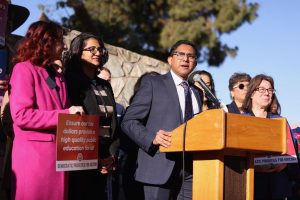
Arizona teachers are fleeing the profession in record levels, and bills being pushed by Arizona Republicans could make the problem worse.
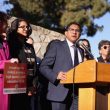
Rather than addressing the problems public schools are facing, Arizona’s Republican lawmakers are advancing bills that will reduce funding for public schools and undermine protections for teachers, and limit teachers’ ability to organize on a labor front, Marisol Garcia, president of the Arizona Education Association, the state’s largest teacher’s union, said in a virtual news conference.
Last year, a judge ruled that Arizona schools are some of the worst funded in the country—and that the state fundamentally failed to meet its constitutional obligation to fund public schools.
The ruling just scratches the surface of what educators have to work through each school year, Garcia said, and masses of teachers have left the profession as a result.
READ MORE: Arizona teachers push ballot measure to end school voucher fraud
“Year after year, we continue to lose colleagues, friends, [and] we find it increasingly difficult to meet the expectations that parents and other community members lay upon us,” Garcia said.
More than 1,000 teachers left the industry during the 2025-2026 school year, and over 700 made their exit before the school year even started, according to a report from the Arizona Department of Education.
“We have lost over 1,000 teachers who are hardworking…who are exhausted by the low pay, the working conditions, and lack of respect from their elected officials,” Garcia said.
Elimination of unions for public school employees
House Concurrent Resolution 2040 is designed to eliminate education unions like the Arizona Education Association—prohibiting school districts from using any public resources to support labor organizations.
It would prevent school employees from distributing any information about labor unions with the use of public resources—like printing union information with school equipment, and it prohibits union meetings from occurring on school property.
The proposal is a ballot referral, and if passed, HCR2040 would go straight to voters rather than Democratic Governor Katie Hobbs’ desk, who would likely veto it.
If voters pass the measure, it would place even more restrictions on educators’ ability to advocate for higher pay and better working conditions.
The Arizona Education Association is ready to organize and oppose the measure if it passes and is sent to voters, Garcia said.
“Its [HCR2040] intention is to take away educators’ right to work together to find solutions for problems that they are facing,” Garcia said. “Teachers are courageous, they’re compassionate, and we’re not asking to be billionaires, we’re not asking for tax credits, free homes, free health care, what we’re asking for is the ability to do our jobs and make decisions in our job spaces.”
Other labor unions in the state have spoken out against HCR 2040 as an attack on working Arizonans.
“This ballot measure would prevent educators from being able to exercise their rights to free speech and assembly in their own communities…this is a blatant government intrusion on educators’ rights in the worst way,” according to a statement from Fred Yamashita, Secretary Treasurer & Executive Director of Arizona AFL-CIO.
Attacks on teacher’s first amendment rights
House Bill 2313 would prevent teachers from striking against their school district or charter school. Violations could result in districts losing funding from the state Education Department.
The bill specifically outlines that teachers “may not strike or engage in an organized work stoppage,” and describes a work stoppage or strike as a coordinated effort between at least two teachers, according to its language.
If two or more teachers are out sick, the bill could target them for organizing a strike and prompt an investigation, Garcia warned.
“Arizona educators put up with a lot of restrictions, accountability, from the moment that we cross over into our gated parking lots,” Garcia said. “This is just overreach for government purposes…this is just a very scary step.”
The Republican-controlled House passed the measure Thursday, but Hobbs will likely veto it.
Expired public school funding
Arizona voters approved Proposition 123 in 2016, a ballot referral that restored a portion of the inflation dollars that were withheld from public schools during the Great Recession—enabling funding paid out from the State Land Trust to flow to public schools.
The funding, which distributed about $300 million among K-12 public schools each year for a decade, expired in 2025, and lawmakers are now debating its renewal for the third year in a row. Arizona’s state general fund has provided the missing education funding in the meantime.
Rather than extending Prop 123 in its current form, the Republican-majority legislature has attempted to tie the extension to ESA-school voucher expansions. This year, they are attempting to overhaul it completely with Senate Concurrent Resolutions 1041 and 1051.
Both measures present the guise of expanding Prop 123, but instead work in tandem to undermine educator pay by narrowing the definition of teachers who are eligible for salary increases, and allowing school districts to reduce base salaries if student spending drops. This would create more year to year uncertainty about salary levels and state funding for salaries, Garcia said.
“This legislature should be talking about: ‘How do we keep great teachers in our state? How do we make sure that they don’t leave for New Mexico, that has a higher salary, or Nevada that has a higher salary and benefits package?’” Garcia said.