He was on his way to work installing drywall when immigration agents stopped him that February morning. He told them he was the father of two disabled children who used wheelchairs. The agents told him, “I’m sorry,” but said they still had to arrest him.
Erasmo Ibuado-Reyes was targeted by immigration agents as part of a crackdown that President Donald Trump said would focus on the “worst of the worst” people who were in the country illegally.
At a federal court hearing, though, a judge described Ibuado-Reyes as being among the best of the people who had appeared before him in such cases.
Magistrate Judge John Boyle lauded Ibuado-Reyes for his 20-year work installing drywall at the Feb. 17 hearing.
MORE: Deported Arizonan struggles to adjust. ‘I feel like I’m worth nothing’
“And from what I can tell, doing nothing but supporting your family, which has to be more difficult in your circumstance, and your family’s circumstance, than many,” Boyle said from the bench.
The judge ordered Ibuado-Reyes released from criminal custody ahead of his pending trial. But he wasn’t freed. Rather, he was taken into immigration custody, and on March 7, he was removed to Mexico, a Homeland Security spokesperson said.
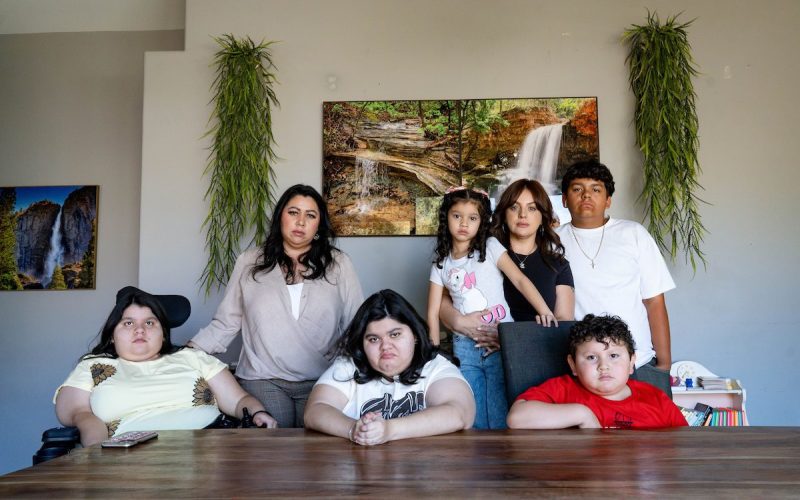
His wife of 25 years, Rosa Verenice-Calderon, finds herself in the home the family moved into 10 years ago, raising her four children without the financial and emotional support her husband provided.
“Right now, I don’t know what I am going to do,” she said during an interview at the house.
In Mexico, Ibuado-Reyes said he feels lost and unsure what comes next for his family.
“I’m just suffering,” he said during a phone interview with The Arizona Republic. “I’m in agony.”
Ibuado-Reyes moved in with his parents, who run a ranch in Ciudad Cuauhtemoc, in Chihuahua, Mexico.
Days after his deportation, the family made the 12-hour drive from Phoenix to visit him.
The two parents saw that their special needs children, both born with mitochondrial disease, would not do well in Mexico.
The sidewalks in the city were uneven and had no ramps, not friendly to the wheelchairs her daughters use.
Verenice-Calderon said the medical services her daughters would get in Mexico pale in comparison to those in the United States. Plus, she said, she felt the sting of discrimination against people with disabilities during their days there.
“There is no life for my children there,” she said.
Verenice-Calderon knows she has decisions to make about her family’s future. But during a March 26 interview with The Republic, she said she had no definite answers on how they would stay in their home.
“We still haven’t processed what’s happening to us,” she said.
Among the questions she has is why her husband was targeted for removal, as if he were the criminal element that Trump promised to root out of the United States.
“I agree that criminals should be arrested,” she said. “But it really seems unfair to people who came here to work.”
Targeted arrests of immigrants involve extensive surveillance
Federal prosecutors filed more than 10,800 immigration-related cases in Arizona courts since Trump took office in January 2025, according to statistics released by the U.S. Attorney’s Office for the District of Arizona.
A sliver of those, more than 1,150 cases, were filed in the U.S. District Court in Phoenix, according to a database of cases kept by The Republic.
A smaller segment of those, 310 cases, were persons targeted specifically for arrest by Immigration and Customs Enforcement or Homeland Security Investigations officers.
Among those was Ibuado-Reyes.
Such cases take time and resources, according to Todd Lyons, the acting head of ICE.
Lyons, during an April 2025 roundtable with journalists, said such arrests are preceded by hours of surveillance, tracking a person’s habits and patterns.
The arrest itself can involve as many as 10 agents, Lyons said.
For that reason, Lyons told reporters, the agency must prioritize who it goes after.
A spokesperson for the Homeland Security office in Phoenix would not say what in Ibuado-Reyes’ past made him a priority. In an email, the spokesperson said he was targeted for arrest because he was in the country illegally.
The criminal complaint filed in his case showed that ICE officers received a “non-biometric lead,” a euphemism for a tip, on Feb. 3.
A Homeland Security spokesperson would not discuss the nature of that tip.
One week later, according to the complaint, Ibuado-Reyes was targeted for removal. Agents “encountered (him) after conducting surveillance near a residence and performed a vehicle stop in Phoenix, Arizona,” the criminal complaint said.
Verenice Calderon said her husband had no idea who might have called immigration authorities about him. She said the couple got along with their neighbors and had no enemies.
Ibuado-Reyes said he doubted whether there was a tip at all.
“I think they just stopped me,” Ibuado-Reyes said, “They saw a work truck.”
What happened the morning this Phoenix dad was arrested by ICE
On Feb. 10, Ibuado-Reyes left his house around 7 a.m., heading for a construction job about 45 minutes away.
Near 27th and Highland avenues, he saw law enforcement vehicles turn on their lights. One vehicle pulled in front of him and the other behind him, he said, boxing him in.
Ibuado-Reyes said he grabbed his phone and dialed his house as six officers approached his work truck.
Verenice-Calderon was brushing her 5-year-old daughter’s hair to get her ready for school when her phone rang. It was about 10 minutes after her husband had left the house.
Her 7-year-old son looked at the screen and said it was “Papi.” She said she told him to answer it.
Ibuado-Reyes only had time to ask his son to let his mom know police had pulled him over.
Verenice Calderon tried to grab the phone, but her husband was already gone. He didn’t answer when she tried to call back.
The ICE officers asked Ibuado-Reyes for identification. He said he showed them his Mexican consular identification card. They asked him to step out of his vehicle.
Ibuado-Reyes said he told the officers he had two daughters who used wheelchairs. In his truck, he said told them, was a wheel from one of his daughter’s chairs. He was going to work on repairing the mechanism in the hub that day, allowing it to more easily attach to the chair.
“They said they couldn’t do anything,” he said. “I had to go.”
His wife opened the program that would show the location of her husband’s phone. She saw its destination: The ICE office in midtown Phoenix.
Verenice-Calderon went to pick up her husband’s work truck from where he was detained. She put the broken wheel back on her daughter’s chair. She had to take her to a doctor’s appointment that afternoon.
She said she didn’t speak with her husband until the next day, when he called from the Florence detention center.
Ibuado-Reyes described the center as crowded. He soon got sick, with a sore throat, watery eyes and chest congestion.
Because of a prior deportation in 2011, he was facing a criminal charge and needed to go to court.
‘You’ve done nothing but work hard’
Ahead of his hearing, Verenice-Calderon said, an attorney from the federal public defender’s office told her that her husband faced a prison sentence of between three to six months for his felony crime.
Verenice-Calderon took her two older children, both adults, to the hearing in their wheelchairs. Her younger children, 7 and 5, were in school.
Ibuado-Reyes, clad in an orange jumpsuit and in shackles, saw his family in court and felt sad.
“It hurt a lot to see them,” he said. “I know they need me.”
He thought of all he used to do for his children, helping to bathe them, lifting them out of bed and into their chairs. He said he thought of his wife having to take care of all four children on her own.
“I couldn’t do anything about it,” he said, “because I was detained.”
The hearing was to determine whether Ibuado-Reyes should be released from the custody of the U.S. Marshal’s Service ahead of his trial. Many defendants are routinely granted such release under a federal law, the Bail Reform Act.
That law requires judges to release people unless they were a danger to the community or there was no way to outfit them with an ankle monitor or find another way to reasonably ensure they would show up for their court date.
But such assurances are difficult to find when the person stands accused of being in the country illegally.
In the more than 800 felony re-entry cases brought before judges in the Sandra Day O’Connor U.S. Courthouse in downtown Phoenix, judges have routinely granted the government’s request to hold the person.
They have cited their strong ties to another country and the risk they would flee there rather than face a trial.
But the judge hearing Ibuado-Reyes’ case said he thought the man before him was different than the others.
“He has all the ties and the work ethic and the things you would expect for someone who might show up in court,” Boyle told the assistant U.S. attorney in the case, “except he is facing removal.”
The prosecutor, Matthew Greve, said Ibuado-Reyes had family in Mexico and an incentive to flee.
He also brought up a blemish on Ibuado-Reyes’ record: A 2011 incident where he violated a protective order put in place by his wife.
Greve said that showed Ibuado-Reyes had a history of not following court orders.
Verenice-Calderon, in her interview with The Republic, said the couple had gone through a rocky time in their marriage.
She said they were told by doctors that their daughters were likely to die in four years. It led to arguing, she said, but her husband was never physical with her.
She booted him from the house and placed an order of protection against him. When he later showed up to the house, she said, a relative called Phoenix police. He was not charged with a crime, but was removed to Mexico.
He returned to the United States, and the two went through years of counseling, Verenice-Calderon said.
Boyle, during the hearing, said he weighed that 2011 violation along with other arrests mentioned in a report in front of him. Though he told Ibuado-Reyes those arrests were “far before you were a working adult” and held very little relevance.
A spokesperson for Homeland Security, in an email, listed off two additional prior arrests of Ibuado-Reyes. One was for shoplifting in April 1998, and another was for disturbing the peace in Denver in January 2011.
The Republic could find no records for either arrest. The judge, citing the report, said there were no convictions from those arrests.
Citing the report on Ibuado-Reyes’ background in front of him, Boyle said, “Everything I see here indicates that you’ve done nothing but work hard to try and support (your family), especially your two special needs children who need you more than anything.”
Boyle, in court, called Ibuado-Reyes’ family life for the past 15 years “admirable.”
The judge, ordering Ibuado-Reyes’ release, said it was likely not to have a practical effect, as he would face immigration proceedings.
That is what happened. He was sent to an immigration holding facility in Eloy.
Ibuado-Reyes said after he was moved to immigration detention, he applied for asylum. It was denied.
“That’s when I thought (that) there was no opportunity,” he said. He signed a paper that led to his deportation and agreeing he couldn’t apply to legally return for 10 years.
Days after he was removed to Mexico, prosecutors filed a motion to drop the criminal case against him.
‘I always think about him’
On a morning in late March, the family gathered around the kitchen table for a video call with Ibuado-Reyes, something that Verenice-Calderon said happens two to three times a day.
“Here are your children,” Verenice-Calderon told him in Spanish over the phone.
“Hello, my son,” Ibuado-Reyes said to his 7-year-old. “I miss you a lot, my children.”
After the call, the family sat motionless for several seconds, quietly sobbing.
“It’s sad,” said Shirley Ibuado Calderon, the couple’s 25-year-old daughter. “I always think about him.”
It was Ibuado-Reyes who would help lift Shirley and her sister, Itzel, out of their wheelchairs and into bed. He would also help bathe them.
This, his wife said, came after a long, hard day of hanging drywall.
On weekends, he grilled food outside for family gatherings, his wife said.
The house payment was coming due. Verenice-Calderon said she was getting help from relatives to pay the bills, but knew that couldn’t last forever. “It’s not sustainable,” she said.
In Mexico, Ibuado-Reyes said he was paralyzed with worry. “How will my wife stay in the house?” he said. “How will she take care of my children?”
He said he doesn’t feel in the right mind to make decisions about the future.
He said he doesn’t understand how a purported effort to target criminal immigrants ended up sweeping him up.
“I was just working,” he said. “I was taking care of my children and my wife.”
Reporting by Richard Ruelas, Arizona Republic