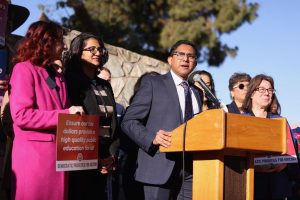
Arizona Secretary of State Adrian Fontes and Attorney General Kris Mayes, both Democrats, are among the first elected officials to pledge legal challenges to Trump’s order, arguing he’s unlawfully trying to control who gets to vote.
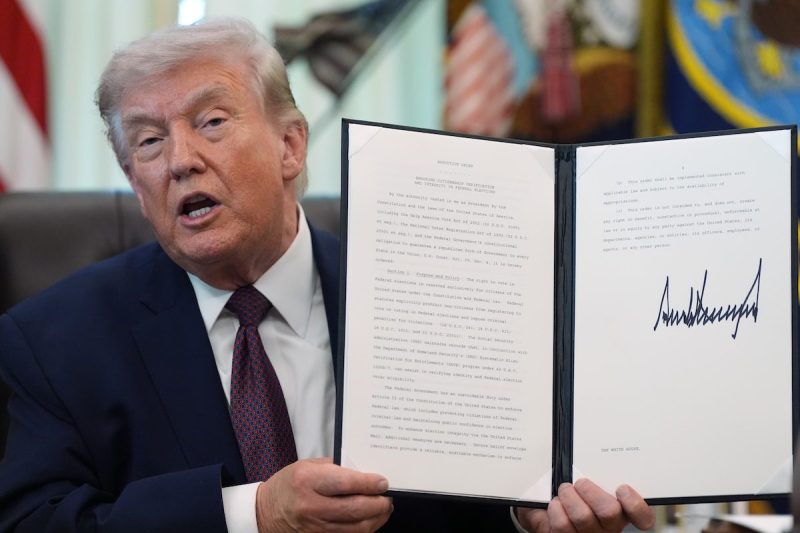
President Donald Trump on Tuesday signed an executive order to heavily limit mail-in voting, which the majority of Americans, 80% of Arizonans, and the president himself use to cast their ballots each election.
Trump’s sweeping executive order seeks to limit mail-in voting to people who have been verified by his administration as eligible voters. It directs the US Department of Homeland Security and the Social Security Administration to create a list of voting-age American citizens in each state, sharing it with state election officials.
Trump’s order would also require that the US Postal Service only send absentee ballots to those on each state’s approved mail-in ballot list. This change would upend Arizona’s vote by mail system that 80% of Arizona’s voters use, Arizona Secretary of State Adrian Fontes said.
States would receive updated mail voter lists at least 60 days before federal elections, and the executive order directs state attorney generals to prioritize investigations into cases involving ballots sent to ineligible voters.
If states don’t abide by the order, they could lose federal funding.
Lawsuits over the president’s order are certain, and Fontes said his office is working together with Attorney General Kris Mayes on a legal challenge.
“My office is actively working with Arizona Attorney General Kris Mayes and her team. We will not let this order stand without a fight and will meet the federal government in court to protect the right to vote for every Arizonan,” Fontes said in a statement.
“The President is not trying to improve election security, he is trying to control who gets to vote. That is not his decision to make. We will use every legal tool available to defend Arizona’s elections, Arizona’s voters, and Arizona’s constitutional right to run its own elections,” Mayes said in a statement.
Already, Arizona requires documented proof of citizenship at the time of voter registration, including birth certificates and Native American Tribal ID, on top of voter ID at polling locations, Fontes said in a statement.
“This Executive Order is a disgusting overreach from the federal government and shows how little the Trump Administration understands about election administration. States already deploy rigorous voter roll maintenance efforts to ensure that our elections are safe and secure,” he said. “States run elections and understand what must be done to protect every eligible voter, the federal government does not. This move is nothing more than a push to weaponize the sensitive personal information of voters in this country, an effort my office will continue to fight unrelentingly.”
READ MORE: Justice Department sues Arizona as part of effort to get voter data from the states
Trump and the Republican party have long claimed voting by mail leads to fraudulent ballots, though extensive nonpartisan data shows no evidence of widespread election fraud. Trump still refuses to accept the results of the 2020 Presidential election that Joe Biden won.
Trump’s order—which comes amid plummeting approval ratings and growing unpopularity—escalates his desire to implement presidential control over elections, though under the US Constitution, elections are administered by the states.
“President Trump can sign all the executive orders he wants. It won’t change the United States Constitution. States run their elections, not the President of the United States, not the Department of Homeland Security. That is not a political opinion. It is bedrock constitutional law, and federal court after federal court has said exactly that in striking down this administration’s previous attempts to seize control of American elections,” Mayes said in a statement.