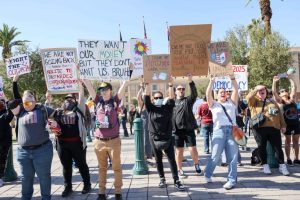
Arizona‘s U.S. senators and the state’s top prosecutor are joining bipartisan calls for answers about an ICE facility in Surprise, including whether the federal government’s plans have gone through the required environmental reviews.
Sens. Mark Kelly and Ruben Gallego sent a letter to the Department of Homeland Security chief Kristi Noem and U.S. Immigration and Customs Enforcement acting director Todd Lyons on Feb. 10, expressing concerns about the future 1,500-bed processing facility in the suburban city northwest of Phoenix.
Arizona Attorney General Kris Mayes sent her own letter to Noem a day earlier, on Feb. 9, after other congressional leaders had demanded answers from the DHS following its purchase of a warehouse off Sweetwater Avenue and Dysart Road for over $70 million in cash on Jan. 23.
Surprise officials and U.S. Rep. Paul Gosar, whose district includes the area of Surprise where the facility is will be, have said they were not aware of plans for the 418,400-square-foot warehouse, which is about 4 miles from City Hall.
MORE: ICE is placing a detention facility in Surprise. Here’s what our readers think
Surprise has since sought legal advice over the planned facility.
The city did not immediately respond for comment about the latest flurry of letters or the merits of senators’ environmental argument.
The lawmakers also blasted DHS and ICE over their lack of communication over the detention center.
“We are deeply concerned by the lack of meaningful engagement with local leadership prior to this acquisition,” Kelly and Gallego said in the letter obtained by The Arizona Republic. “Which follows a pattern for how the department has conducted immigration enforcement under this administration.”
DHS’s failure to follow the longstanding practice of obtaining local input before acquiring property in urban areas “undermines the principles of cooperative federalism and threatens to seriously erode trust between federal agencies and the communities that host federal facilities,” Kelly and Gallego said.
The senators also challenged whether department’s plan complies with the National Environmental Policy Act, which requires the federal government to review environmental and community impacts when planning projects. They said that though DHS could be excluded from a mandated environmental review, that could not be applied in this case.
One expert, said Elise Bennett, a senior attorney for the Center for Biological Diversity, said that in some cases, it appeared the federal government doesn’t care about the environmental impacts of its actions.
Mayes, a Democrat, noted an unusual political alignment generated by concerns over the controversial facility.
“Even Congressman Paul Gosar asked a number of questions about the suitability of this facility for Surprise, and quite frankly when I read Congressman Gosar’s letter, it struck me that he was asking the kinds of questions that go into a possible nuisance lawsuit,” Mayes said at a Feb. 10 news conference. Mayes called the facility a “seven-football-field- sized, essentially, prison, that they want to plop down in the middle of the city of Surprise.”
Her three-page letter suggests she could turn to the state’s public nuisance law to try to stop the facility.
Her administration has used the law in new ways, including while trying to stop groundwater pumping by foreign farming giant Fondomonte in La Paz County and against a planned mine in Yavapai County. It is unclear how powerful a legal tool it is, as courts have not yet said whether the law can be used as Mayes contends.
Nationwide concerns over DHS projects and lack of environmental review
One of the major concerns expressed by the members of Congress is whether the Department of Homeland Security conducted the necessary environmental reviews before acquiring the Surprise warehouse.
The National Environmental Policy Act requires federal agencies to undergo an environmental review before enacting a “a major federal action.” Kelly and Gallego said that DHS’s purchase of the warehouse fits that definition.
If the property was being used for its intended purpose, the agency could potentially get an exemption.
But Kelly and Gallego argued that using an industrial warehouse for processing immigrant detainees is a change in the functional use of the property, and therefore, is subject to federal environmental review.
“Given the potential for significant impacts related to the Department’s acquisition and conversion of a warehouse into a detention facility, an environmental assessment is appropriate to ensure the city of Surprise has a full understanding of these impacts, particularly with regard to the city’s water usage, utilities, and traffic,” they said.
The landmark environmental law does not only apply to pristine natural areas. It also requires the government to review major projects that affect the environmental quality of communities.
“Environmental impacts are defined pretty broadly under the National Environmental Policy Act, so it’s not just impacts to endangered species or a river. It can also be impacts to air quality, increased traffic, noise or if it changes the scenic enjoyment of people in the area,” Bennett, said.
In June 2025, the Center sued Noem over a mass immigration detention facility in the Florida Everglades known as “Alligator Alcatraz” and the project’s compliance with environmental law.
The National Environmental Policy Act also requires the government to share an overview of what the project is expected to be and to open public comment periods to allow citizens and stakeholders to voice their opinions its impacts.
“In our experience with the DHS project we’re dealing with is there has been zero public transparency,” said Bennett. “Even when we’ve submitted Freedom of Information Act requests, we’ve been getting nothing back. That is unusual, to say the least, for any kind of project that requires NEPA.”
Kelly and Gallego said that the size of the facilities and the “aggressive schedule” with which DHS was planning to open them across the nation raised serious concerns about whether sufficient planning and environmental review had been conducted.
Their letter included 13 specific questions, similar to those posed by Mayes and the other congressional leaders, including how the facility will be operated, the estimated cost to create and run it and how the federal department plans to communicate with local and county leaders in the future.
Kelly and Gallego also asked if DHS had determined the facility would have no significant impact on the environment. If not, they asked, “Under what categorical exclusion or other relevant authority is the Department relying on to bypass these required reviews?”
Kelly, Gallego and Mayes asked to hear back no later than Feb. 17.
Reporting by Elena Santa Cruz, John Leos and Stacey Barchenger, Arizona Republic