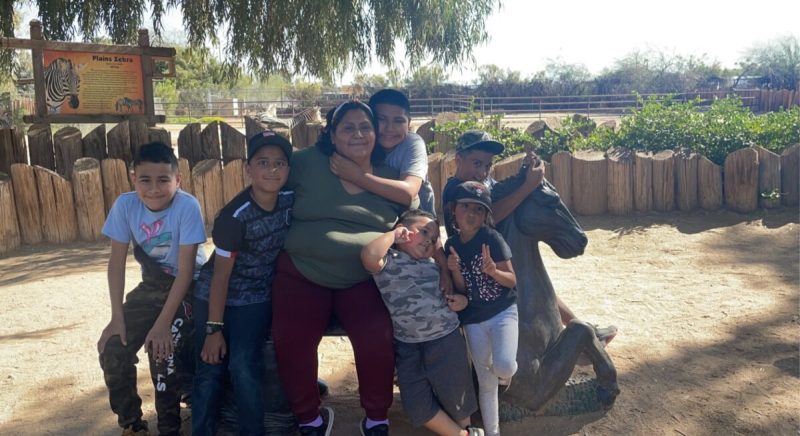
Norma Lopez-Acosta cleaned hotels, houses, and dishes to afford a modest life in Phoenix, raising her six children mostly on her own. Now, she sits in ICE custody.
For years, Norma Lopez-Acosta woke up bright and early, often before the sun came up at 5 a.m., to get ready, wake up her six children, and walk over to the local Food City to purchase whatever breakfast they could afford, usually conchas and Gatorade for each of her kids.
After this early morning ritual, Norma and her children would catch the city bus, a commute that took hours, in order to get to their destinations—for Norma, her place of work, and for her kids, their nearby school.
Norma spent decades cleaning hotels, houses, dishes, jumping from one backbreaking job to the next to make ends meet and ensure her children stayed fed.
After 29 years of work that took a dramatic toll on her body, and with adult children who were finally able to help her pay the bills, she was, in recent years, able to stop overworking and spend quality time with her children and grandchildren.
She often beamed to her daughter, Rosalba Lopez-Acosta, about how she’d finally made it in American society; she could now afford to buy her grandson McDonalds without stretching dollars. She could now pay for nice school supplies for her grandchildren, a luxury she couldn’t afford while struggling to make ends meet as an undocumented cleaning lady in Arizona.
“When my kids play sports, she’s always showing up for them. She always says ‘I wasn’t able to do that with you because I always had to be working.’” Rosalba said. “[Now] she shows up for everybody.”
That all came crashing down on Jan. 2.
The day started like any other, with Norma waking up, getting ready to go to her job as a dishwasher, and calling her oldest son during her commute. As she drove, she noticed a brown van trailing her in her rearview mirror, but didn’t think much of it, according to Rosalba.
The 53-year-old mother and grandmother continued chatting with her son, when police lights began flashing behind her, Rosalba said.
Unaware it was Immigrations and Customs Enforcement (ICE) agents behind her, Norma hung up the phone, believing she was simply being pulled over. Because Norma didn’t meet the description of the “criminals” President Donald Trump pledged to target for deportation, she didn’t think much of it at the time, according to Rosalba.
But the family knew better.
In a panic, her son, who she was on the phone with and whose identity we are keeping anonymous due to his undocumented status, called fellow family members to inform them that he’d lost contact with his mother after she’d been pulled over. While they didn’t know yet that it was ICE who had stopped her, they knew she was in trouble regardless of whether it was local police or ICE.
In Arizona, undocumented people are unable to obtain a driver’s license, and the lack of identification has landed immigrants in ICE detention.
Norma’s son located her via a location-sharing application and instructed his younger brother, Angel Zenon Lopez, who was born in the US, to bike to the area where their mother was to ensure her safety, according to Rosalba.
When Angel arrived at the scene, he saw ICE agents behind the front seat of his mother’s car, parking the vehicle before driving off in their own vehicles, Rosalba said.
Witnesses videotaped the incident, which showed the family’s worst nightmare come true: their mother in handcuffs being whisked away by ICE agents.
Upon hearing the news of her mother’s detention, Rosalba said she broke down in tears.
“We didn’t know what to do,” she said.
Video of Norma’s arrest.
Life in the US
Norma grew up in Mexico City. Her mother was an alcoholic and in a turbulent relationship with her step-father. Norma had to work in minefields as a child laborer in order to help her family pay the bills.
To this day, she has lower back injuries she obtained from working in the mines, and the pain severely hinders her mobility, according to Rosalba. By the time she reached her early 20s, and shortly after her parents died, Norma knew she wanted more for herself and her three young kids, and began to consider a life in the US.
In 1997, her sister made the journey to the US with the help of smugglers. After her sister settled in Arizona, Norma made the decision to join her with her three children about a month later. A few months later, her then-partner joined, Rosalba said.
Once in Arizona, Norma worked extensively to make ends meet. She gave birth to three children, including Rosalba, who are all US citizens.
Norma and her partner had a difficult, on-and-off relationship, and she was mostly a single mother trying to feed six mouths. Rosalba remembers moving from apartment to apartment, getting Christmas presents from the Salvation Army, and her mother having to scrap money together to afford a decent Thanksgiving meal.
Despite her difficult circumstances, Norma was a law-abiding member of the community. She kept her head down to avoid attracting unwanted attention. Once, while driving her children home, a police officer pulled her over and asked for her identification, according to Rosalba.
Luckily, the officer did not give Norma a ticket for her lack of an ID, but instructed her to leave the car behind and walk home. For 20 years, she did not drive again out of fear, according to her daughter. The family grew accustomed to public transportation.
Rosalba’s childhood was defined by seeing her mother being exploited, working day and night to make ends meet for her and her siblings.
“We grew up very poor, but [she] never left us without a meal. She would always feed her kids first. [She’d make] sure we were all full, and then she would eat whatever scraps that were left over,” Rosalba said.
While it was devastating for the family to see their mother overworked her entire life, Rosalba believes she is who she is today, a hardworking and driven woman, and a teacher in the Glendale Elementary District, because of her mother.
“The person that I am today is because of my mom. She was the only role model that I looked up to,” Rosalba said.
Three decades of backbreaking labor left a physical toll on Norma’s body. The grandmother of 11 suffers from pain all over her body, including leaking spinal fluid and numbness in her legs.
Now that they’re grown up, Rosalba and her siblings were looking forward to paying their mom’s bills and allowing her to finally rest rather than continue to work through pain, high-blood pressure, and diabetes.
When Rosalba gave birth to her children a few years ago, a new world opened up for Norma. She went to her grandchildren’s sporting games, cooked them meals, and was able to exist as a person and grandmother, rather than as a worker stuck in survival mode.
“She always has this guilty conscience, like ‘I’m giving [your grandchildren] everything I couldn’t give you guys,’” Rosalba said. “We tell her it’s okay. I’m glad you’re able to experience a normal motherly kind of connection and bond. You should have been able to experience that with all of us.”
A family’s nightmare
Since learning about her mother’s detention by ICE, Rosalba has struggled not to blame herself.
“I felt like I didn’t do enough to protect her from this situation,” she said.
During her time in the US, Norma explored pathways to citizenship, but abandoned that pursuit out of fear she’d be denied and promptly deported, a fear many undocumented immigrants share. Instead, Norma opted to live a quiet life and remained optimistic she wouldn’t get caught in the crosshairs of Trump’s mass deportation agenda, despite her family’s constant concern.
“I was just scared that we would lose her,” Rosalba said.
When that nightmare became reality, Rosalba battled her inner thoughts: I should have driven her to work, I should have woken up earlier, I shouldn’t have let her go to work. These thoughts played on a loop as she scrambled to go to the Walmart to pick up the car her mom left behind and take her pressure medication to the ICE Field Office in Downtown Phoenix.
Rosalba has heard the horror stories of immigrants being detained and families struggling to find their loved ones. Once she heard from her mother, she instructed her to call the family as often as she could so they could ensure she was safe. They still double check her location on ICE’s online detainee tracker each day, just to be sure of her location.
Rosalba quickly began searching for an immigration lawyer, which can cost $15,000 or more.
Some lawyers she consulted with asked for hundreds just for a consultation, while others asked for the full payment beforehand. Rosalba knew the family didn’t have the means to afford that. Thankfully, they found a lawyer who specializes in personal injury law, but has a background in immigration law, and launched a GoFundMe to help pay for the expenses.
Life in detention
Prior to her detention, Norma once told her children that if she were to be arrested, she’d sign papers to self-deport, believing an older woman like herself wouldn’t be able to tolerate the conditions within ICE facilities.
“She just wanted to avoid any mistreatment by [ICE]. That was her mentality,” Rosalba said.
Now, Norma has instead vowed to fight her case and is in the process of obtaining a bond. Still, it hasn’t been easy to adjust to her new normal inside the Eloy Detention Center.
Media outlets have reported on a history of unsafe conditions with the facility, which is operated by the for-profit group CoreCivic, including lack of proper medical care, dehydration, and mistreatment of detainees.
When Norma arrived, she was offered clothing that was too small for her, leaving her back exposed. She told her daughter that it’s extremely cold within the facilities, a claim echoed by other detainees who spent time in Eloy. Norma complained about the quality of the food, too, saying it’s not “really food,” citing nutritional deficiencies.
The Copper Courier reached out to ICE to ask about Norma’s detention and conditions at Eloy, but the agency did not respond to a request for comment.
In a phone call with her daughter, Norma cried, questioning what she did to deserve imprisonment, saying she’d never broken a law and did everything she could to keep her family safe and alive.
Luckily, Norma has been warmly embraced by fellow inmates, some of whom have been detained for far longer than her, and have offered her additional food and resources to help her adjust to her new life behind bars.
“She called them her little angels,” Rosalba said.
Norma has nothing left for her in Mexico, according to her daughter. Her parents died when she was a teenager, and her only real family, her sister, also resides in the US. If Norma were to be deported to Mexico, Rosalba said she and her siblings would take turns visiting her to help her build a semblance of a life for herself in a country she no longer knows.
“Her whole entire life is here in the United States. She really has nothing to go back to,” Rosalba said.
Norma’s 11 grandchildren are struggling to adapt to life without their grandmother. Rosalba’s oldest son, who is eight years old, broke out in tears after speaking with his grandmother after her detention.
Despite the heartache, the family is committed to getting their mother out of Eloy, and raising awareness about who the Trump administration is going after—mothers and grandmothers.
“What this administration is telling you is just lies,” Rosalba said. “They want to portray someone that came to this country for a better life, as criminals. It’s ordinary people that are just here trying to make a living and a life for their family and kids.”
The family set up a GoFundMe to help with legal assistance. It can be found here.