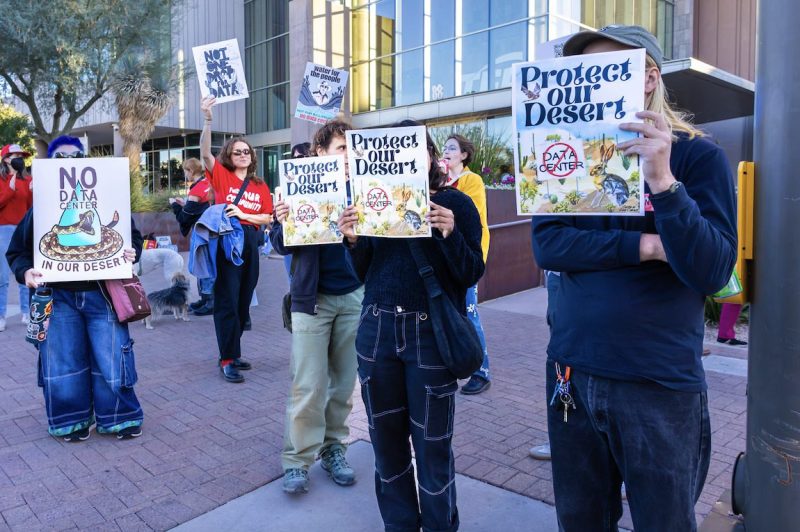
The No Desert Data Center Coalition, Worker Power, and other local activists garnered thousands of signatures to let Marana residents decide the fate of a proposed data center campus in the town.
As data centers pop up across the country, Arizona activists have shown up to city council meetings, the Arizona Corporation Commission, Board of Supervisors meetings, and before other government bodies to oppose their construction here at home.
Now, they’re taking the issue directly to voters with a ballot referendum.
On Wednesday, the No Desert Data Center Coalition, along with Worker Power and other local residents in southern Arizona, submitted two petitions with about 2,800 signatures each to the town clerk. The petitions seek to put a proposed hyperscale data center campus in the town on the ballot and overturn the rezoning decision made by the town council earlier this year, instead giving local residents a chance to make their voices heard at the ballot box.
“Our elected officials failed to protect us, but the people have taken action. We will not allow Beale to build harmful hyperscale data centers in our communities,” the coalition said in a press release.
Where would the data centers be built?
The data center campus would be built in the town of Marana in southern Arizona. According to the town website, the site consists of two adjacent parcels which are each about 300 acres in size and owned by separate entities, and would operate as a coordinated data center campus.
The plans were met with fierce opposition from concerned residents throughout the process.
In December, residents packed the Marana Planning Commission as the commission weighed recommending a rezoning request for the data center campus. The two-hour long meeting heard from more than two dozen speakers mostly opposing the rezoning request. Despite opposition, the commission voted unanimously to recommend the town council rezone the land.
On Jan. 6, residents continued to make their opposition known at the Marana Town Council chambers, holding signs to encourage the council to oppose the rezoning request. After hours of public comments, every Marana town council member voted in favor of the rezoning request, except council member Herb Kai, who was not at the meeting and whose family owns one of the land parcels.
The proposed data center developments would be powered by for-profit utility group Tucson Electric Power (TEP) and not-for-profit electric cooperative group Trico Electric, and each site would use an estimated 550 to 750 megawatts of electricity, according to the town website.
Beale Infrastructure, the developer behind the plans, has not specified who the customer would be for the data center, and the town website said it is unclear who would operate the center.
How data centers can harm the local community
Data centers have been a hot button topic over the past year as they continue to pop up all over the country to meet the demand brought on by the rapid rise in artificial intelligence. Data centers store, process, and manage significant volumes of digital data through computing machines and other equipment in one centralized location to meet the needs of businesses, but they can come with a cost for local residents.
Data centers have led to higher electric bills for nearby residents and drained water resources, leaving local residents to deal with the aftermath while developers earn a profit.
While the town website says the data centers would not lead to air pollution, studies show that communities located near data centers, even ones regulated by the Environmental Protection Agency (EPA), have higher rates of air pollution compared to the national average.
Despite the risk to the environment and local residents, President Donald Trump has promoted AI data centers with policies meant to fast track their development.
Within data centers, computers trying to keep pace with the demands of the AI boom often end up overheating. The computers must be cooled off in order to continue functioning, and developers most often turn to either water or air-based cooling methods. While efficient, these methods use copious amounts of water or energy at a time when Arizona has been in a drought for more than 20 years.
As the state approaches the summer months, activists are sounding the alarm that Arizonans need to be prioritized for access to electricity and water resources, not computers.
“Data centers around the country are sending electric bills skyrocketing for residents and local businesses, and many TEP and Trico customers are already struggling to pay high bills, especially during the summer months,” the coalition said in a statement.
If approved, the referendum will likely be scheduled for an election later this year, according to a town spokesperson.