Under President Trump’s “Big Beautiful Bill,” Arizona must cut down on its Supplemental Nutrition Assistance Program (SNAP) error rate by 2028. If this goal isn’t met, the state government will be forced to make a choice between raising taxes or cutting programs that keep kids fed at school.
Trump’s bill includes a provision that says states must maintain an error rate for SNAP payments of under 6%. If the rate exceeds 6%, the state will be responsible for paying out benefits to residents instead of the federal government. Arizona’s SNAP error rate in 2024, the most recent year measured by the US Department of Agriculture, was 8.84%.
“Error rate” refers to how much a state government overpays or underpays its SNAP recipients. Discrepancies can happen because of clerical and casework errors or honest mistakes people make while filling out application forms. Elevated error rates do not equal fraud. Fraud refers to intentional errors, like falsely listing extra dependents or incorrectly reporting a lower income to earn benefits.
Arizona’s overpayment rate was 7.56% and underpayment was 1.28%.
If that error rate held into 2028, the state government would have to pay 10% of all SNAP benefits. A state with error rates of 6%-8% would have to pay 5% of benefits, while a state with an error rate of 10% or higher would be required to pay 15% of recipients’ benefits.
Before Trump’s “Big Beautiful Bill,” the federal government equally split SNAP administrative costs with US states. States will take on an extra 25% burden starting in 2027.
According to the Arizona Department of Economic Security, that means an increase of $35 million per year in administrative costs.
The Arizona Joint Legislative Budget Committee, a bipartisan committee in the Arizona Legislature, estimated an increase in over $200 million dollars from the state government to keep SNAP afloat in 2028.
That’s money the state would need to find somewhere by increasing taxes, cutting programs, or a combination of the two.
Hungry kids could pay the price for SNAP changes
Roughly 780,000 people were enrolled in SNAP in Arizona in 2022, and around 340,000 of those people were children, per USDA data.
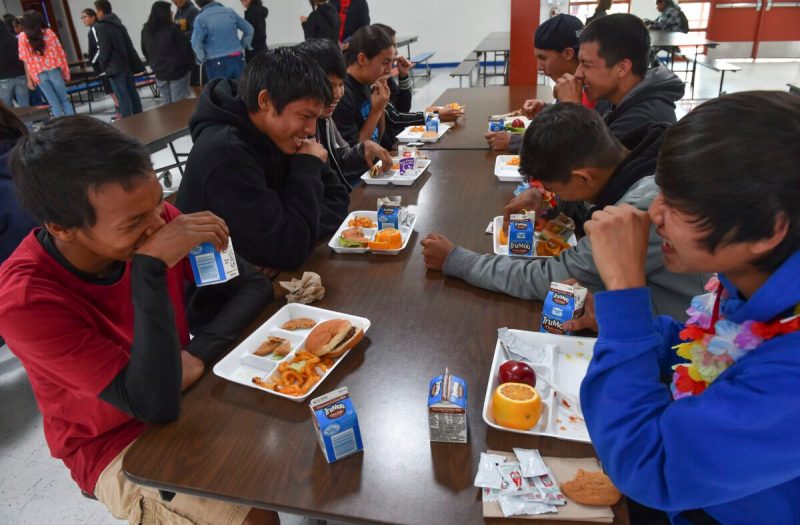
SNAP enrollment doesn’t just offer a way to feed children at home—it’s also a critical gateway to free school meals. When a family is enrolled in SNAP, the children in that family are automatically enrolled for free school meals. No additional paperwork or separate application with the government is needed.
The Community Eligibility Program (CEP) allows schools to serve every student a free meal if at least 25% of enrolled students at a school are eligible for free meals.
Over 300,000 school districts in Arizona adopted the CEP in at least one school within the district, and nearly 500,000 children attended schools that adopted the CEP, according to data from the Food Research and Action Center and the Center on Budget and Policy Priorities.
Proponents of SNAP say giving every child at a school a free meal reduces stigma, cuts down on administrative burden that comes with means-testing, and increases participation.
Any threat to SNAP enrollment threatens families who already meet eligibility, kids who get free lunches, and kids whose families don’t qualify for SNAP but get free breakfast and lunch at their schools through the CEP.
SNAP erosion means poor Americans could get even poorer, and people whose children are enrolled in CEP schools have an additional expense.
Arizona’s entire Republican Congressional delegation—Reps. Andy Biggs, Juan Ciscomani, David Schweikert, Eli Crane, Abe Hamadeh, and Paul Gosar—all voted for Trump’s “Big Beautiful Bill.”
Biggs and Schweikert are running to be Arizona’s next governor in 2026.
Arizona’s entire Democratic Congressional delegation—Reps. Yassamin Ansari and Greg Stanton, along with Sens. Ruben Gallego and Mark Kelly—voted against the bill.