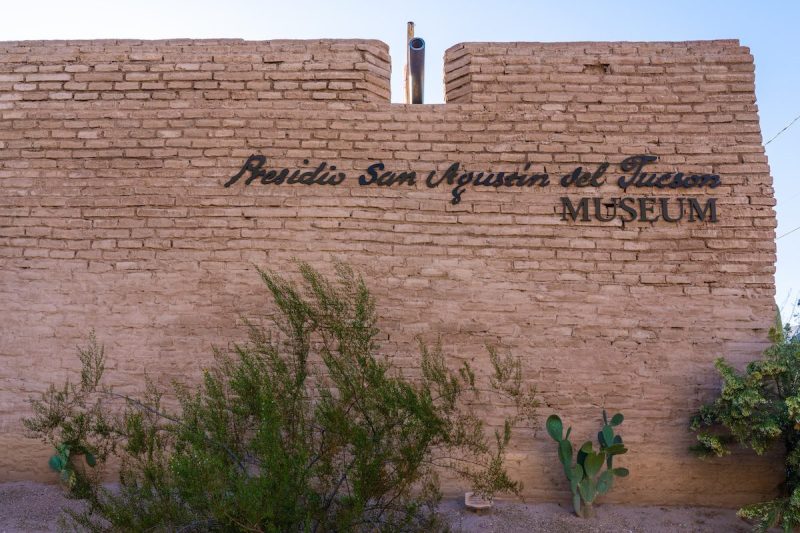
Shaded by a sweet orange tree, visitors milled about the dirt-floor courtyard of a historic house that is now the Presidio San Agustín del Tucson Museum, on a breezy Tuesday afternoon.
About 250 years ago, in that same courtyard, children played ball, while mothers prepared food, tended gardens, and soldiers practiced their drills.
Back then, it wasn’t a house or a museum — it was a fortress and the founding building of a fledgling community that would grow to be Arizona’s second largest city.
MORE: How Lincoln and Eleanor Ragsdale helped desegregate Phoenix
In the early years of Tucson, the presidio was the northernmost outpost of Spain, and it looked out onto green fields tended by the Tohono O’odham, who had lived there for thousands of years.
The lives of the people in and around the fortress were marked by violence, new beginnings and hard work.
This is the story about how Tucson’s history was built, almost lost, and saved.
Spain chose Tucson as ideal location for a fort
Tucson’s history started 12,000 years before the presidio’s construction, when Paleoindians traveled throughout the Sonoran Desert. For centuries, the O’odham people farmed along the Santa Cruz River, growing maize, beans, squash, and more in fields irrigated by small canals.
In 1775, Spain established an outpost on a terrace overlooking the Santa Cruz River floodplain called the Presidio San Agustín del Tucson. It was located near the O’odham town of Cuk Son.
The presence of Native Americans— for their labor and the ability to convert them to Christianity— was just one of the reasons they chose the location, Thiel said. The verdant farmlands the Tohono O’odham developed and the Santa Cruz River, made the area an ideal location for Spain to establish a presidio to protect its missions and settlements from Apache raids.
Native American labor was needed to help build the presidio.
“They could hire them to help make adobe bricks,” said archaeologist Homer Thiel.
Life inside the Presidio walls
It was these sun-dried adobe bricks that made up the walls of the 11-acre fortress. What started out as a wooden palisade, or a wall made of tree trunks placed closely together, became an adobe brick wall one year after an immense Apache raid. The walls measured about 670 feet across.
Thiel said the fort was built in the shape of a square with walls as high as 12 feet. Towers sat at the northeast and southwest corners.
“It was one of the largest adobe forts ever built here in North America,” Thiel said.
Inside the fort were living quarters, as well as a blacksmith, guardhouse and church. The commander’s house sat in the middle.
People entered the presidio by a “massive” mesquite door that opened onto current-day Alameda Street and Main Street, according to John Bret-Harte, in his book “Tucson – Portrait of a Desert Pueblo.”
The smell of homemade food from the communal ovens and trash likely wafted out into the open yard.
Remnants of plants, animals and human waste were thrown out haphazardly, Thiel said, likely causing the presidio to smell badly by today’s standards.
“They just threw all their trash out into the areas in front of their houses, so we find layers of trash,” Thiel said about archaeological discoveries, like animal bones.
Harsh life on the isolated frontier shaped residents
Life was harsh in the isolated outpost, Thiel said, with the nearest stores over 100 miles away in Sonora at Imuris or Arizpe.
“It was a hard existence, but people held on,” he said.
Apache attacks were common in the fortress’ early years, but after a group of Apache settled near the presidio, life was temporarily peaceful.
Between 400 and 500 residents lived inside with 100 of them soldiers, Thiel said. The soldiers acted as guards, patrolled the region and guarded the animals the Spaniards used, including cattle and horse herds.
Soldiers lived in mostly windowless, bare quarters built along the walls.
Instead of doors, most used animal hide that could be rolled up or down, Thiel said.
“There was a connected chain of little one-room houses all around the inside of the wall,” said Hilario Gallegos, who was born at the Tucson presidio, in a 1926 interview. “The houses had openings or doorways and some of them had doors. A few had window openings… none of those windows had glass; we didn’t know anything about glass in those days.”
The rest of the population, Thiel said in a blog post, included the wives, children, and servants of soldiers and civilian families.
Women prepared food, reared children and tended the gardens. Children also helped out from a young age.
“Boys were sent out to agricultural fields on the nearby floodplain to tend to crops, guard cattle and sheep, and to kill rabbits, rodents, and birds that came to the fields looking for a meal,” Thiel wrote.
Girls were taught homemaking skills like cooking, sewing and repairing clothes, as well as when to plant gardens, and how to preserve food.
Tucson becomes part of Mexico, then U.S.
Presidio San Agustín wasn’t the only Spanish installation in the area. Just across the Santa Cruz River Mission San Agustín del Tucson was founded in 1771 by Eusebio Francisco Kino, a Jesuit missionary.
Kino also had previously founded another mission, San Xavier del Bac in 1692, located just south of Mission San Agustín. Construction was completed in 1797 and remains in use to this day.
Along with the Spanish came European diseases.
“There was a lot of European diseases that were decimating the Native American population,” Thiel said.
In 1815, Spanish soldiers from Tucson were sent to Mexico to fight against revolutionaries in the Mexican War of Independence. After Mexico won the war, the fledgling government was left bankrupt. It ended the system of providing the Apache with supplies and removed soldiers from the presidio.
The Apache began raiding again, and the number of soldiers protecting the fort decreased by almost half, according to Thiel.
In 1854 after the Gadsden Purchase, Tucson became part of the United States, and two years later, Mexican soldiers withdrew from the fort.
Under both Mexican and American governments, the O’odham lost much of their land, despite being granted equal rights.
“The demand for land for settlement escalated with the development of mining and the transcontinental railroad,” according to the Tohono O’odham Nation. “That demand resulted in the loss of O’odham land on both sides of the border.
Violent relationship between Apache, others led to massacre
The Apache were several related bands of Indigenous groups who were often nomadic and known for being fierce warriors and raiding.
The refusal of many Apache to convert to Catholicism, and the discovery of valuable minerals on their lands, led to clashes between the Spanish and the Apache.
“Apache survival depended on taking advantage of whatever opportunities the desert offered,” according to the Apaches of Aravaipa Canyon. This included raiding cattle during times of scarcity.
Violence continued to increase as Spanish retaliated and the Apache “called for retribution.”
According to the group, Apache traded more than raided. But eventually, any attack on a homestead or wagon was blamed on the Apache.
“All this then set the stage for the subsequent massacre of Apache civilians at Aravaipa, who had sought the protection of Camp Grant against the escalating violence,” according to Apaches of Aravaipa Canyon.
Camp Grant was an American military outpost established where the San Pedro River meets he Aravaipa Creek. The massacre occurred in 1871 after the Apache agreed to stop fighting and was carried out by a group of American vigilantes based in Tucson and Tohono O’odham, said historian Janice Cotrell.
Presidio and mission disappear
Over the years, the presidio walls were torn down, with some adobe bricks reused for new structures. For more than six decades, the location of the fort almost vanished.
In 1929 a former city engineer found the presidio wall while building the domed Pima County Courthouse, Thiel said.
Then in 1992 Thiel and a team of volunteers found remnants of the wall using the a map made by the former city official.
The San Agustín mission also disappeared over time. Thiel said most of the mission site was destroyed in the 1950s when Tucson built a landfill over it, but a few portions remain intact.
Most of Tucson’s founding sites have dwindled to a small number of remnants. A part of the presidio wall rests at the Southern Arizona Heritage and Visitor’s Center, and artifacts live on at the presidio museum.
At the mission’s former site, a nonprofit operates Mission Garden, with plants from Kino’s time and earlier.
Tucson’s history also remains alive in modern-day Tucsonans descended from Indigenous communities and presidio residents.
“There are probably thousands of people living in Tucson descended from the people that lived in the fort,” Thiel said.
Reporting by Sarah Lapidus, Arizona Republic