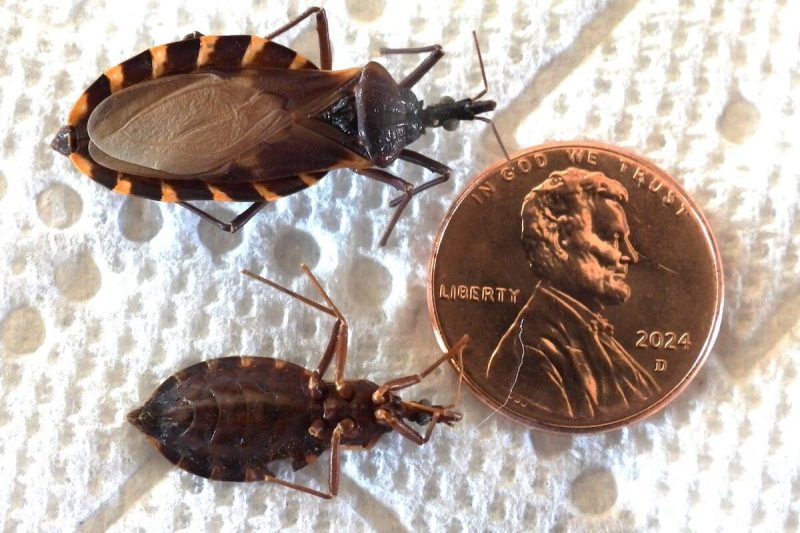
Kissing bugs may sound romantic, but Arizona locals know there’s nothing sweet about them. These insects earned their nickname because they often bite around the mouth and eyes, and visually, they are hard to miss.
They are about one-inch long and flat with cone-shaped heads and distinctive orange or red stripes along the edges of their dark bodies. Kissing bugs are attracted to light and the warmth of their hosts. When seeking a blood meal, they are drawn to the heat emitted by mammals, including humans.
Want Arizona news in your inbox each morning? Sign up for our free newsletter.
The real connection with kissing bugs is Chagas disease, caused by a parasite they can carry. Not every bug is infected and not every bite transmits the parasite.
Here is everything to know about kissing bugs and whether they are common in Arizona.
Are there kissing bugs in AZ?
There are seven species of kissing bugs in Arizona. Three of them — Triatoma rubida, Triatoma protracta and Triatoma recurve — are most common in Phoenix and Tucson.
Are kissing bugs harmful?
Kissing bug bites themselves aren’t usually dangerous, but the real risk comes from the Trypanosoma cruzi parasite they carry, which causes Chagas disease. Although not every kissing bug carries the parasite, transmission happens when the bug defecates near a bite and the parasite enters through the wound, eyes or mouth.
Why should you not squish a kissing bug?
You shouldn’t squish a kissing bug because doing so can actually increase the risk of exposure to the parasite that causes Chagas. If you squish them, their bodily fluids can smear on your skin, bedding or other surfaces.
What to do if you find a kissing bug?
If you suspect you have encountered a kissing bug, avoid handling it directly. Its feces can transmit the Chagas disease parasite. Use gloves or a tissue to collect the bug for identification.
If you want to confirm the identity of a kissing bug, contact local pest control professionals or entomologists.
What does Chagas disease do to a person?
According to the Centers for Disease Control and Prevention, Chagas disease is a tropical infection caused by the parasite Trypanosoma cruzi.
The acute phase of the illness may present with mild or no symptoms. If left untreated, the infection can progress to a chronic stage, potentially leading to severe cardiac and gastrointestinal complications.
How likely is it to get Chagas disease?
The actual risk of getting Chagas disease is lower than many people think. In fact Chagas disease is not considered common in Arizona.
“Chagas has been found locally in Arizona, but it is very rare,” according to the Maricopa County Office of Epidemiology and Data Services.
How to detect Chagas disease?
Chagas disease can have both acute and chronic phases, each with its own set of symptoms.
According to Johns Hopkins Medicine, symptoms of the acute phase can be fever, headaches, fatigue and body aches.
The chronic phase of Chagas disease can lead to more serious and potentially life-threatening complications such as cardiac issues and digestive system disorders.
Is Chagas disease curable?
Chagas disease is treatable if caught early. During the acute phase, which could be the first few weeks to months after infection, benznidazole and nifurtimox can usually clear the parasite if treatment begins soon after infection.
During the chronic phase, which is years after infection, the parasite can linger silently for decades. In this stage, some people never develop symptoms and others may have heart or digestive problems.
Everyone’s curing process will look different, but early treatment with antiparasitic medications significantly improves outcomes, according to the Centers for Disease Control and Prevention.
Got a story you want to share? Reach out at Tiffany.Acosta@gannett.com. Follow @tiffsario on Instagram.
Looking for the best things to do in Arizona? Sign up for our newsletter.
This article originally appeared on Arizona Republic: Are there kissing bugs in Arizona? Everything to know and the risk of Chagas disease
Reporting by Tiffany Acosta, Arizona Republic / Arizona Republic