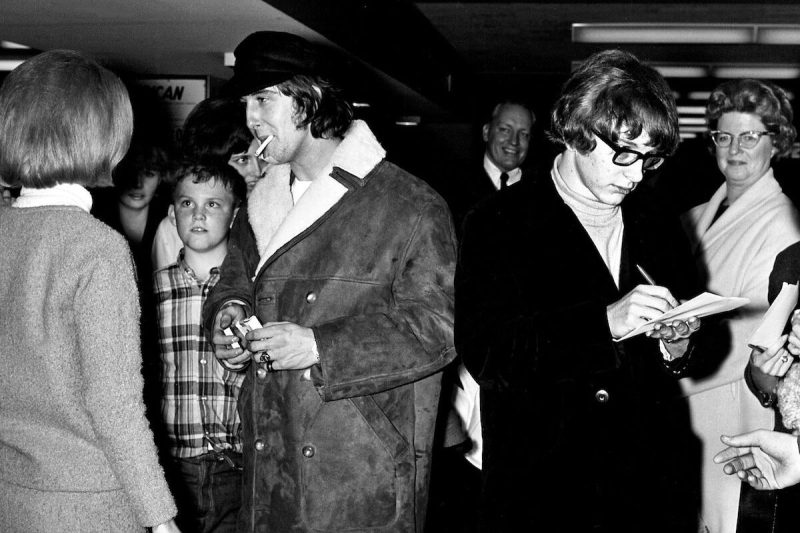
Beatlemania had reached a fever pitch by June of 1964 when Peter Asher and his singing partner, Gordon Waller, became the first British Invaders other than the Beatles to hit No. 1 on Billboard’s Hot 100 — an “extraordinary” feat, as Asher calls it, that they managed to accomplish with their debut single “A World Without Love.”
“As you know, in the late ’50s, we in Britain had fallen completely in love with American music — blues and R&B, in particular,” Asher says.
“But at that point in time, pre-Beatles, British acts did not have hits in America. It just wasn’t done, if you think about it. Acker Bilk ‘Stranger on the Shore’ and Lonnie Donegan ‘Does Your Chewing Gum Lose Its Flavour (On the Bedpost Overnight)?’ were about where it was at. And then suddenly, that all changed.”
MORE: The story behind Linda Ronstadt’s “Long, Long Time”
It was 1964, the week of Feb. 1, that the Beatles first hit No. 1 on Billboard’s Hot 100 with “I Want to Hold Your Hand,” which held that spot for seven weeks before another Beatles hit, “She Loves You,” started its own two-week run, which was followed by five weeks of “Can’t Buy Me Love.”
“At that point, the British Invasion was largely The Beatles,” Asher says. “At least, they kicked the door down and the rest of us leapt on through it.”
How Paul McCartney’s love life helped Peter and Gordon hit it big
The Beatles’ involvement in Peter and Gordon’s success went beyond merely kicking the door down.
Paul McCartney wrote the group’s first three hits — “A World Without Love” (U.S. & UK No. 1), “Nobody I Know” (U.S. No. 12; UK No. 10) and “I Don’t Want to See You Again” (U.S. No. 16) — all of which were credited to Lennon-McCartney, as were all songs written by McCartney or John Lennon at the time.
As Asher recalls with a laugh, “People actually would say to them, ‘Don’t you mind being knocked off No. 1?’ And of course the answer was ‘No. We wrote the song.’ We’re extremely happy with that arrangement. If anyone’s gonna knock you off of No. 1, better it be a song you happen to have written.”
As to how McCartney came to give this fledgling duo three hit singles, he was dating Asher’s sister at the time.
Jane Asher is an actress and author who occasionally served as a guest panelist on “Juke Box Jury.”
“And she met The Beatles,” Asher says.
“She was actually asked by Radio Times magazine to go and see them the first time they came down to London. This was when they mostly just played Liverpool and Germany. Jane was pretty well known as an actress, and was invited to go and write a piece about what she thought and whether it was worth all the fuss. She met them all after the show and she liked them, they liked her, and one of them liked her in particular.”
McCartney and Jane Asher were one of the British Invasion’s most glamorous couples from 1963 to 1968.
“That meant that Paul would hang around our house a lot, obviously, coming to dinner or bringing his laundry over or whatever,” Asher says. “Eventually, our parents offered him the guest room on the top floor of the house, which he accepted. So he moved in and lived with us for two years. And at that point, I obviously got to know him.”
Asher convinced Paul McCartney to finish ‘A World Without Love’
When EMI Records signed Peter and Gordon, the A&R rep said he liked what he heard in their live show.
“But he also said, ‘Do you know any new songs?’” Asher says. “And I was in a position to go, ‘You know what? Maybe I do.’ Because I had heard this song, ‘World Without Love,’ that Paul had played me, which was a very early song he’d written, I think, when he was 16. John had nothing to do with it.”
In fact, Lennon “despised the song a bit,” Asher continues.
“He thought the first line of lyrics ‘Please lock me away’ was ridiculous. He would go, ‘OK, we’ll lock you away. The song’s over.’ So clearly the Beatles weren’t gonna record it. And Paul hadn’t bothered to finish it. It had no bridge. But I liked it, so I went to Paul and said, ‘Look, we’ve got a real record deal now. What are the chances we can have a go at that “World Without Love” song?’ He said, ‘Fine. You can have it.’”
As the session drew near, he reminded McCartney that the song wasn’t finished.
“So he finally took his guitar and went into his bedroom after I nagged him a little and in a matter of minutes — 5 or 6 minutes at most — he came out with the bridge, (sings) ‘So I wait and in a while, I will see my true little smile,’ that section of the song,” Asher says. “It came out a month after we recorded it, went to No. 1 all over the world and changed my life forever.”
“A World Without Love” was the first of 10 Top 40 singles Peter and Gordon managed on the Billboard Hot 100 between 1964 and 1967.
In addition to those three McCartney songs, they hit with a Del Shannon song, “I Go to Pieces”; Buddy Holly’s “True Love Ways”; a girl-group classic written by Phil Spector, retitled “To Know You is to Love You”; a fourth McCartney song, “Woman”; “Lady Godiva,” “Knight in Rusty Armor” and “Sunday for Tea.”
How Peter Asher came to work at Apple Records
The duo disbanded in 1968, at which point Asher took a job as head of A&R at Apple Records, where he signed a then-unknown James Taylor and produced the singer-songwriter’s eponymous debut.
“I was invited to be head of A&R for Apple, the Beatles label, because Paul and I became friends and he knew that I wanted to produce records,” Asher says. “He actually played on the very first record I ever produced at my request. I took that job obviously because it was an exciting job to have. The Beatles were great to work for.”
Apple Records was a fascinating work environment.
“It was crazy, but not entirely,” Asher says. “People forget that we did put some good records out. You know, some hits. ‘Those Were the Days’ by Mary Hopkin. Paul produced that. George Harrison made a great album with Jackie Lomax.”
The craziness was mostly centered around Derek Taylor’s office.
“When the Hari Krishnas or Hell’s Angels arrived, that’s where they got sent,” Asher says.
“No one knew what to do with them. So they would say, ‘Go see Derek Taylor. He’ll figure it out.’ Because he was brilliant at that stuff. He was officially The Beatles’ P.R. guy, but he ended up doing much more than that. So it was quite hectic but some good music got made.”
It’s Asher’s belief that if Apple had stuck to making records and not tried to move into film and all the other avenues they ended up exploring, it could have been a quite successful label.
“But Allen Klein had other ideas and wanted primarily to manage The Beatles,” Asher says. “So there were huge fights and feuds that went on about that, and it eventually ended up with them all hiring lawyers and writing mean songs about each other and all that stuff, and it all fell apart.”
Why Peter Asher bet his career on James Taylor
Asher managed to stay on at Apple until it dissolved.
“But in the process, I did find a singer-songwriter in whom I believed so strongly that when Apple fell apart, I decided to bet my career on James Taylor and go to America,” he says.
“That’s why I became a manager. Being a record producer was something I had decided to do in and of itself whereas being a manager was something precipitated only by my intense belief in James Taylor that if I thought he was this amazing, other people would think so too. And fortunately, they eventually did.”
As to what he saw in Taylor, Asher says, “Well, kind of everything. I mean, I thought the songs were brilliant, the lyrics were brilliant, his guitar playing was spectacular. He had the skill of a classical guitar player. His phrasing was like Ray Charles or Sam Cooke. So he combined the soulfulness of the music he loved with the skill of an acoustic guitar player. And behind it all was this persona as a sort of lonely sensitive folk singer. And that combination proved irresistible as I hoped it might.”
That first Taylor album, on Apple, was what Asher calls “a moderate success at best.”
Peter Asher looks back on the making of ‘Sweet Baby James’
Their luck improved after the relocation to America.
“I dropped James on the East Coast for a bit of rehab that he needed at the time, and I went out to California and got him a new record deal with Warner Bros,” Asher says. “And we prepared to make the next album, which ended up becoming a big hit record.”
Produced once more by Asher and released in 1970, “Sweet Baby James” hit No. 3 on Billboard’s album chart and spun off two hit singles – “Fire and Rain,” which peaked at No. 3, and “Country Road,” which peaked at No. 37.
Asher stayed on as producer for the next two albums — “Mud Slide Slim and the Blue Horizon,” which sent “You’ve Got a Friend” to No. 1 on Billboard’s Hot 100, and “One Man Dog,” which included another big single, “Don’t Let Me Be Lonely Tonight.”
“The early albums were very complicated because he was a junkie, and they are complicated people to work with,” Asher says. “And I knew nothing about that whole area at the time. I just thought he was really tired a lot. So that affected things. He could be a bit silent and morose in some of the early days, but he was great. We became firm friends and we still are. We were speaking yesterday.”
After working with other producers for three albums, Taylor returned to Asher for a string of hit albums — 1977’s “JT,” 1979’s “Flag” and 1981’s “Dad Loves His Work.”
Linda Ronstadt as ‘one of the greatest singers I’ve ever heard’
By the time they reconvened to work on “JT,” Asher had begun producing records for the other superstar with whom he’s most associated, Linda Ronstadt — a woman he refers to “one of the greatest singers I’ve ever heard in my life.”
The first album they worked on together was “Don’t Cry Now,” although it was a work in progress by the time he got involved.
Released in October 1973, “Don’t Cry Now” hit No. 45 on Billboard’s album chart, a new career high quickly overshadowed by her next release, “Heart Like a Wheel,” which topped the Billboard album chart in 1975 and spun off two huge singles — “You’re No Good,” which topped the Hot 100, and “When Will I Be Loved,” which peaked at No. 2.
“‘Heart Like a Wheel’ was the one where we actually started from scratch and that did very well for us,” Asher recalls.
“So Linda and I stuck together for a long time, including, of course, the mariachi albums and the Nelson Riddle albums, which were a very different venture and she very graciously retained me to produce those as well. So we did a lot of different kinds of records and they were all interesting in different ways.”
Asher was far from the Svengali people think he was for Ronstadt
The hits kept coming, including such classics as “Heat Wave,” “Blue Bayou,” “It’s So Easy” and “Ooh Baby Baby,” by which point she’d become the most successful female rocker of her generation, selling out “stupid” arenas, as she called them when she spoke to The Arizona Republic.
“I think she did that just by being really good,” Asher says. “She did shows that were great. She sang amazing. Basically, what she had to sell was her song choices and her singing, which were both spectacular, you know?”
Asher did have input on what songs she ultimately ended up recording.
“But it’s very far from being the Svengali people sometimes wish to write about me as,” he says. “People would jump to that conclusion. Or they did then anyway. Linda would run into a lot of ‘Don’t you worry pretty little head about that’ attitudes from people who assumed that I was making the key decisions. But in fact, they were always joint decisions, the career decisions and the song choices and so on.”
And if there was a vote that held a bit more sway in those decisions, Asher says, it wasn’t his.
“Linda always had the last word,” Asher says. “As she should have. And I suppose we lucked out, you know? We made some song choices people agreed with. And she became the first giant arena rock ‘n’ roll chick, and deservedly so. Then it turned out, of course, that she could amaze everyone by singing everything — La bohème and rancheras — all spectacularly well. And taking it all very seriously.”
By the time she brought him in to handle the production on 1989’s “Cry Like a Rainstorm, Howl Like the Wind,” their final album-length collaboration, Asher had produced or co-produced 13 Ronstadt albums, including three chart-toppers (“Heart Like a Wheel,” “Simple Dreams” and “Living in the USA”).
And that last album featured two more massive pop hits — the Aaron Neville duets “Don’t Know Much” and “All My Life.”
Asher also produced Bonnie Raitt, Cher and Barbra Streisand
His production credits also include hit albums for Bonnie Raitt (“The Glow”), Cher ( “Cher” and “Heart of Stone”), 10,000 Maniacs (“In My Tribe” and “Blind Man’s Zoo”), Diana Ross (“I Love You”) and Stevie Martin with Edie Brickell (“Love Has Come For You”).
His latest effort, Barbra Streisand’s “The Secret of Life: Partners, Volume Two,” hit the Billboard album chart at No. 31 in July 2025.
He plans to keep producing records, Asher says, “Until I’m either deaf or dead, whichever comes first.”
He’s also still touring, bringing his Songs and Stories Tour to the Musical Instrument Museum in Phoenix for two shows on Friday, Dec. 19.
“I’ve been doing variations around the theme for some time with different-sized bands and different people,” Asher says.
“On this occasion, it’s a sort of scaled-down show a bit, more of a straightforward acoustic show with a couple of musicians, terrific players. I start at the beginning, really, and talk about my various adventures in the music business and the interesting people I’ve met along the way.”
Peter Asher: Songs and Stories
When: 3 and 7:30 p.m. Friday, Dec. 19.
Where: Musical Instrument Museum, 4725 E. Mayo Blvd., Phoenix.
Admission: $49.50-$59.50.
Details: 480-478-6000, mim.org.
Reporting by Ed Masley, Arizona Republic