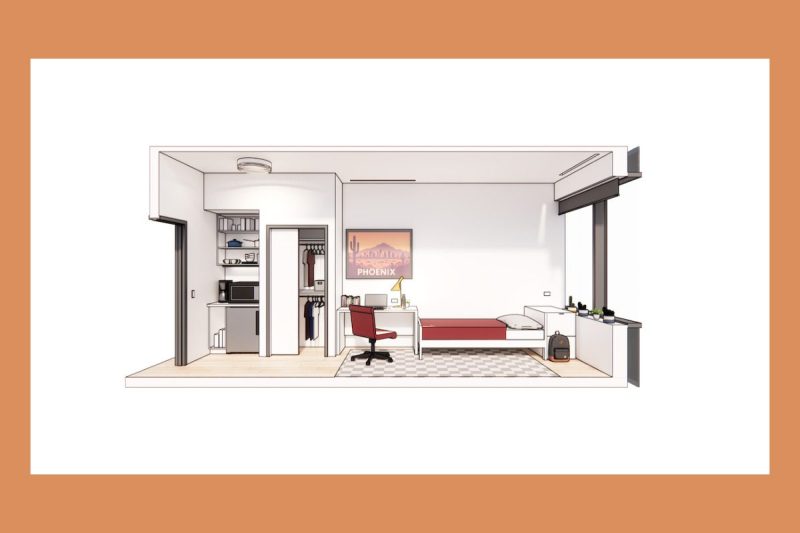
A new report imagines how Phoenix could expand its housing supply by converting empty office space into co-living apartments.
This story first appeared in Rent Check PHX, a biweekly newsletter made for Phoenix renters, written by someone who’s lived it. Sign up for it here.
Here’s a fact that won’t surprise anyone: Phoenix doesn’t have enough housing for everyone who lives here, and that’s keeping prices painfully high.
But here’s something you may not have known: Downtown Phoenix has too much office space, with 23% of it currently sitting vacant.
A new report from The Pew Charitable Trusts, a nonpartisan nonprofit, and Gensler, an international architecture and design firm, asks the question: What if we converted that empty space into co-living apartments—small, private rooms with shared bathrooms, kitchens, and living space?
Office space can be difficult logistically to convert into traditional apartments, but the report’s authors argue that co-living apartments could be an easier and more cost-effective transition.
In the report’s model, renters pay $850 a month for a 160-square-foot furnished bedroom. That may sound like a terrible deal—but the rent includes the shared spaces, access to a fitness center, daily cleaning of common spaces, 24-hour security, and all utilities, including internet.
One thing it wouldn’t include, though, is any on-site parking—a fact many Phoenicians may balk at. Part of what makes the model more cost-effective is the fact that it could be built while bypassing the city’s typical parking requirements. The idea is that if people are living downtown closer to public transit and in a more walkable, bikeable area, there’s less of a need for them to have cars.
The intended market for these micro apartments is people who make $20,000 to $40,000 a year, but it could appeal to a broader range of renters.
Tushar Kansal, senior officer with The Pew Charitable Trusts’ housing policy initiative, told me that he envisions this model working well for many types of people.
“It could be nurses, teachers, seniors who are on fixed income and can no longer maintain the house that they used to live in,” he said. “It could be students or recent college graduates. It could be your new arrivals to Phoenix.”
While we tend to think of this type of living structure as only for college students—I know I do–it actually used to be more widespread. The report states that this type of single-room occupancy housing was quite common in cities in the mid-20th century.
But Kansal said cities started trying to eliminate this housing in the 1960s and ‘70s.
“The idea was that a lot of these forms of housing … had fallen into disrepair, and we just want to get rid of these. And if we get rid of these, we will be able to get rid of the people who rely on this form of housing, in other words, poor people,” Kansal said. “But as a result, what we have done—all of us as a society—is just gotten rid of a housing option that a lot of people need.”
Kansal said he has not lived in co-living apartments like these, but he says he could picture himself having done so in his early 20s after he graduated from college.
“My first room was an apartment without a window,” he said. “And so this option provides a very nice opportunity for folks to live in a modern, well-maintained apartment that has amenities nearby … and a view of the city.”
Now that this research has been done, Kansal said, it’s passed on to public officials, developers, nonprofits, and more, with the hope that a public-private partnership could make this a reality.
Correction: This story has been updated to reflect that the first named organization involved in the report is The Pew Charitable Trusts.