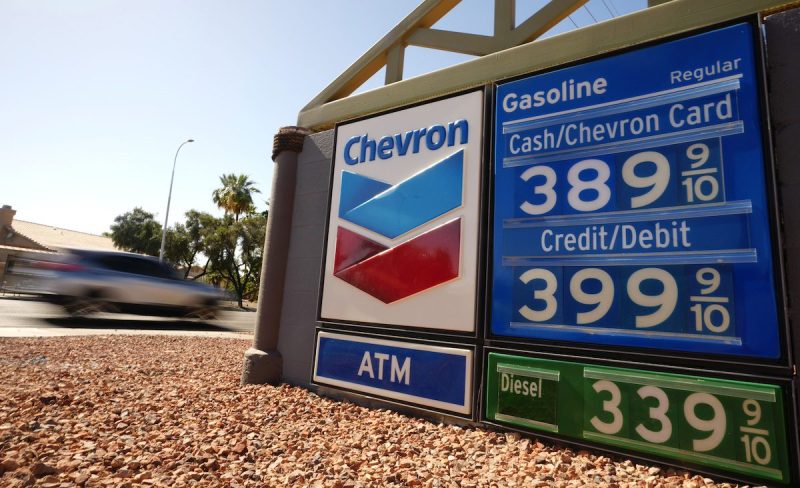
Nav Sapra owns an ARCO gas station on 16th Street in Phoenix. Every day, he decides what price to put on the signs in front of the station.
ARCO changes the wholesale price that they charge him for gas every afternoon. Sapra uses that price to determine how much he’ll charge for gas at the station. Whatever he adds becomes his earnings.
Want Arizona news in your inbox each morning? Sign up for our free newsletter.
“It depends on the owner, if they want to make four, five cents a gallon, or they want to make 15 to 20, 30, 40 cents a gallon,” Sapra said.
The calculations that Sapra makes each day are the final stage of the complex process that determines gas prices. Gas prices can vary dramatically by city and by neighborhood. Even two gas stations on the same street can have different prices. Here’s why.
What affects the price of gas?
The most important determinant of the cost of gas is the price of crude oil, according to Julian Paredes, the representative for AAA Arizona.
The United States is both the world’s top oil producing and consuming country, and it imports a significant amount of oil. The global oil market is affected by geopolitical events like the Russian invasion of Ukraine in 2022, which caused a spike in oil prices. The Organization of the Petroleum Exporting Countries (OPEC) also influences oil prices by limiting how much each of its member countries produces.
Crude oil must be processed at refineries to be turned into gas. Arizona, which doesn’t have any refineries, relies on fuel from neighboring states, said Vince Wolpert, the compliance manager for fuel regulations at the Arizona Department of Agriculture.
“There are two pipelines that feed the state,” Wolpert said. “The majority, 55-60%, comes out of the east, so New Mexico and Texas. The remaining amount of fuel comes out of California, out of the LA Basin-area refineries.”
RELATED: Are there limits on how much Phoenix landlords can raise rent?
Every year, refineries must undergo maintenance, which stops their production for a limited time. Those periods can cause fluctuations in gas prices, since the demand stays the same, but the amount of gas available drops.
Paredes hypothesized that refinery maintenance is the cause of the jump in gas prices in metro Phoenix in August, although he said he’s not certain.
Phoenix prices increased by 59 cents from Aug. 10 to Sept. 10, going from $3.22 per gallon to $3.82, according to AAA’s Fuel Prices database. Other cities in metro Phoenix saw similar jumps; Glendale, for example, saw a price increase of 57 cents.
Although inflation has been slowly pushing up the price of gas over time, in the short term, price increases are cyclical, with the potential for large swings. In 2008, for instance, the wholesale price of gas in Arizona sank from $3.54 to $1.16 gallon between June and November due to the recession.
Why gas prices are different across metro Phoenix
After being refined, gas travels via pipeline to wholesale distribution plants in Arizona.
Various lubricants and chemicals are added to the gas at these plants depending on the brand of gas, which is a major factor in why companies have different prices. ARCO, for instance, has its own unique gas blends, Sapra said.
Tanks of gas are then trucked to gas stations across the state. Metro Phoenix is served by a plant at 53rd Avenue, according to Sapra. That’s partially why Phoenix’s gas is usually cheaper compared to Scottsdale, Mesa and other suburbs — being closer to the plant means the cost to transport the gas is lower.
For station owners like Sapra, city-specific factors like rent, minimum wage and gas taxes also play a role in how much he decides to charge for gas. Currently, state and city taxes come to about 37 cents per gallon of regular gas, he said.
Why Arizona gas prices always rise in the summer
Another seasonal shift in gas prices occurs in the spring and fall in Arizona every year, when refineries switch between a winter and summer gas blend.
“Winter gas doesn’t have to burn as cleanly as summer gas does,” Wolpert said.
The increase in gas prices is typically larger in Maricopa County, which has used a different, cleaner-burning gas blend than the rest of the state since the 1990s. Parts of Pinal County also use the cleaner gas from May through September.
The cleaner-burning gas blend is one of several reasons why metro Phoenix’s gas prices are usually the most expensive in the state.
Gas prices rely on people’s willingness to pay at the pump
The final piece of the gas prices puzzle is consumer demand. For instance, during the summer, when people drive more, the price of gas tends to increase because people are willing to pay more for gas.
The location of the gas station also affects how much gas station owners can charge. In a paper about the economics of gasoline pricing, NorthernArizona State University professor Howard Smith gave the example of two freeway exits for Camp Verde. Gas stations at one exit, easily visible from the highway, charged 17 cents more per gallon than a less conspicuous exit when he visited.
“Local residents avoid the tourist trap while travelers unfamiliar with the local market stop and pay the higher gas price,” Smith wrote.
‘It’s a myth’
Given the tangled web of factors that go into how much gas costs, Sapra understands when customers are shocked by sudden fluctuations in price.
“Everybody thinks, Okay, last time I was here, like a couple days ago, I filled my whole tank with $38, now today it’s $45,” Sapra said. “People are upset. They panic.”
He’s heard his share of complaints about politicians, the state government, station owners like him or other mysterious entities “fixing” the price of gas.
“People say that,” he said. He sighed. “It’s a myth.”
Reach the reporter at reia.li@gannett.com. Follow @reia_reports on Instagram.
This article originally appeared on Arizona Republic: Why do Arizona gas prices fluctuate so much? Here’s why gas price changes every day
Reporting by Reia Li, Arizona Republic / Arizona Republic