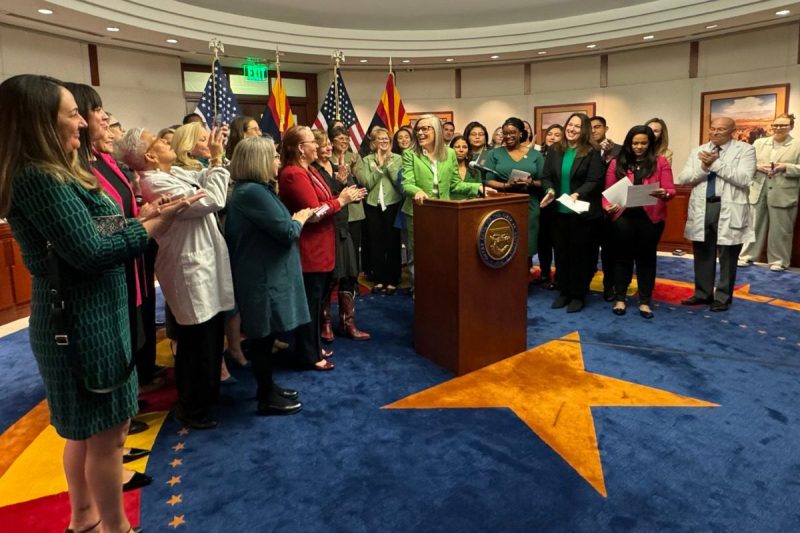
Abortion access is now a constitutionally protected right in the state of Arizona.
Gov. Katie Hobbs certified the state’s election results Monday, and with it, Proposition 139, known as the Arizona for Abortion Access Act. The measure was overwhelmingly approved by voters and gives residents the right to access abortion-related healthcare as recommended by their doctor.
“I was so proud to sign the certification,” said Hobbs. “But before that, when I first took office, I was proud to issue an executive order protecting women and doctors from prosecution by radical county prosecutors—and I want to give a special thanks to Attorney General [Kris] Mayes for making that happen. I also made birth control available over the counter and vetoed several fetal person bills.”
View this post on Instagram
The Arizona Constitution now mandates that “every individual has a fundamental right to abortion” and prohibits the passing or enacting of any state laws that limit that right. It also protects medical professionals and loved ones who help someone access abortion healthcare from legal repercussions.
Several state laws are now in violation of the constitution, such as the 15-week abortion ban. But the laws aren’t automatically repealed; instead, they must be challenged in court, where judges will then rule on the constitutionality of those laws. Mayes, the state’s top law enforcement officer, has no plans to defend any laws that restrict Arizonans’ rights regarding abortion access.
“Laws like the 15-week and 20-week abortion bans, which broadly restrict access before viability, are clearly unconstitutional,” said Mayes. “My office has been analyzing these laws and will be ready to work with healthcare providers and the courts to ensure clarity regarding Arizona’s abortion laws in the coming weeks and months.”
Other laws that could be ruled unconstitutional include a 24-hour waiting period patients must undergo before their doctors can administer recommended abortion care, privacy restrictions relating to the age of the patient, prohibitions on abortion care based on genetic abnormalities, and any accompanying penalties on medical providers for violating these laws.
Despite the constitutional right, some providers may be hesitant to offer comprehensive abortion care until the individual restrictions are relitigated. Dr. Paul Isaacson, a Phoenix-based OB-GYN, said that they hope the courts will decide quickly but will wait until they do so before expanding care to services that could violate the current laws.
“The legal advice I’m getting is to follow the lawsuit, and hope that we get a very quick resolution,” said Isaacson. “But I’m not sure that every provider shares that view.”